Intro to GEFEST
The GEFEST framework is a modular tool for the generative design of two-dimensional physical objects.
The essential points of the framework architecture are shown in figure below.
First of all, the GEFEST receives the boundaries of considered two-dimensional domain as input.
Optimization will be carried out in this domain. Then workflow including polygon encoding,
toolkit constructing and generative design is performed.
At the output, the GEFEST generates samples from the joint probability distribution
P(X, Y).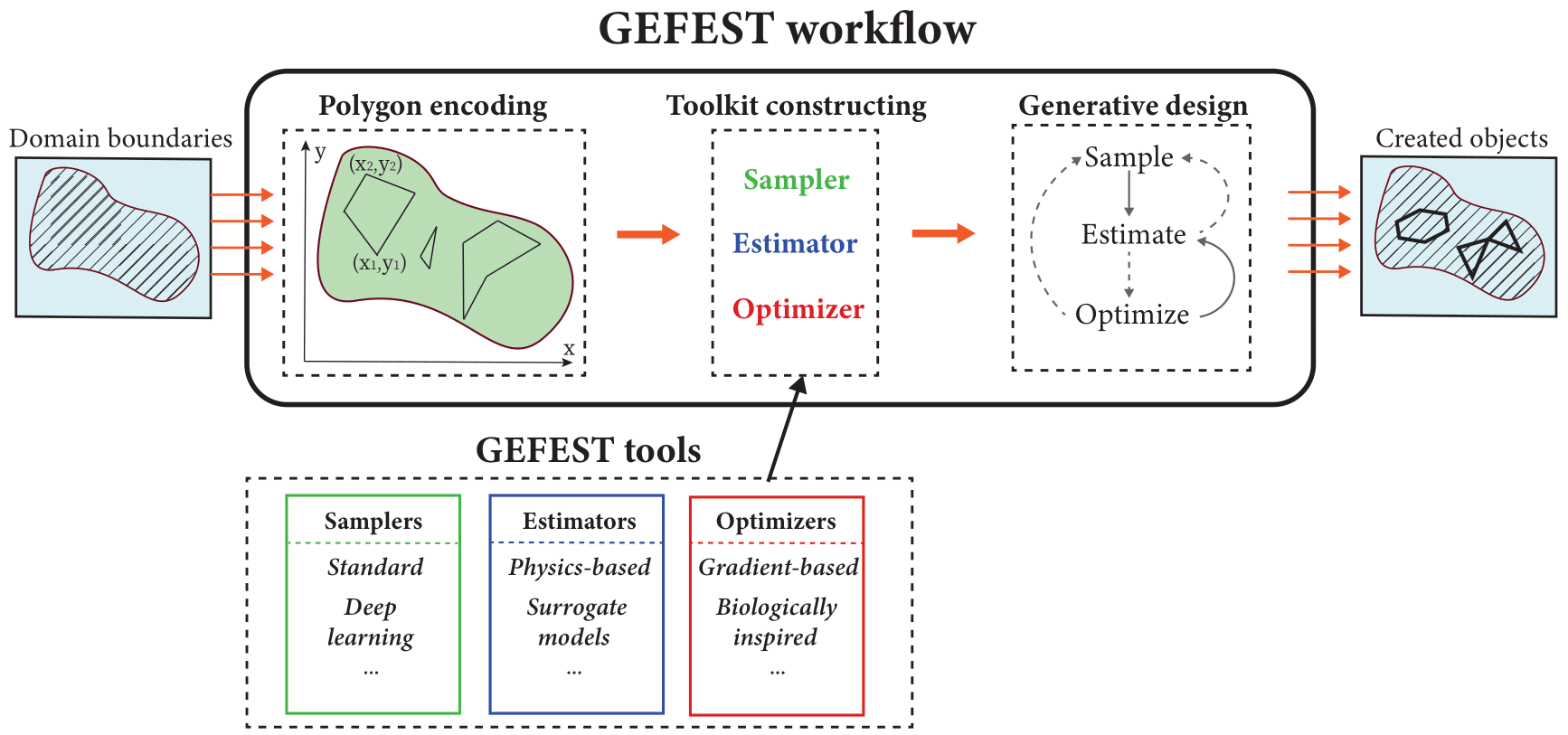
Polygon encoding
The first stage of the GEFEST workflow is polygon encoding.
This procedure allows to represent real physical objects as two-dimensional polygons.
Toolkit constructing
After the specification of the design space, it is necessary to set a certain approach for each stage of the generative design procedure.
To accomplish this purpose, we have implemented GEFEST tools (Samplers, Estimators, Optimizers) including various computational methods.
Generative design
The fundamental stage of the GEFEST workflow is the generative design, depicted as last step in picture a head.
This procedure is based on three principles: sampling, estimation, optimization, which can be combined in different ways.
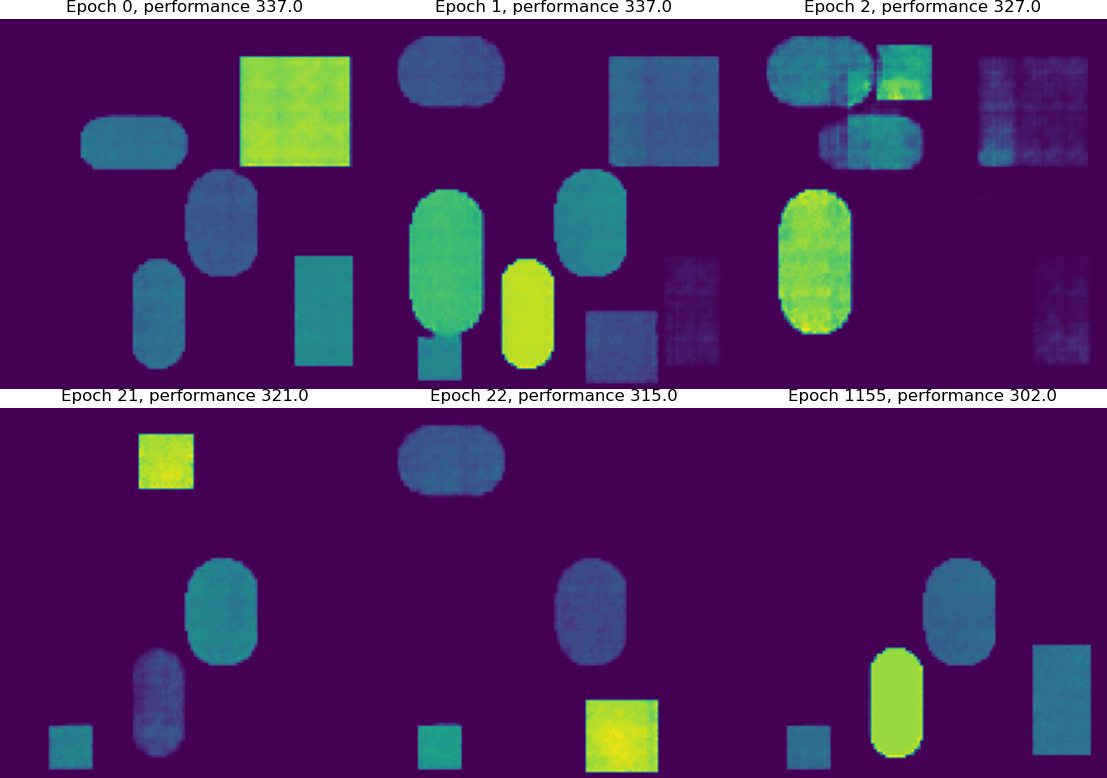
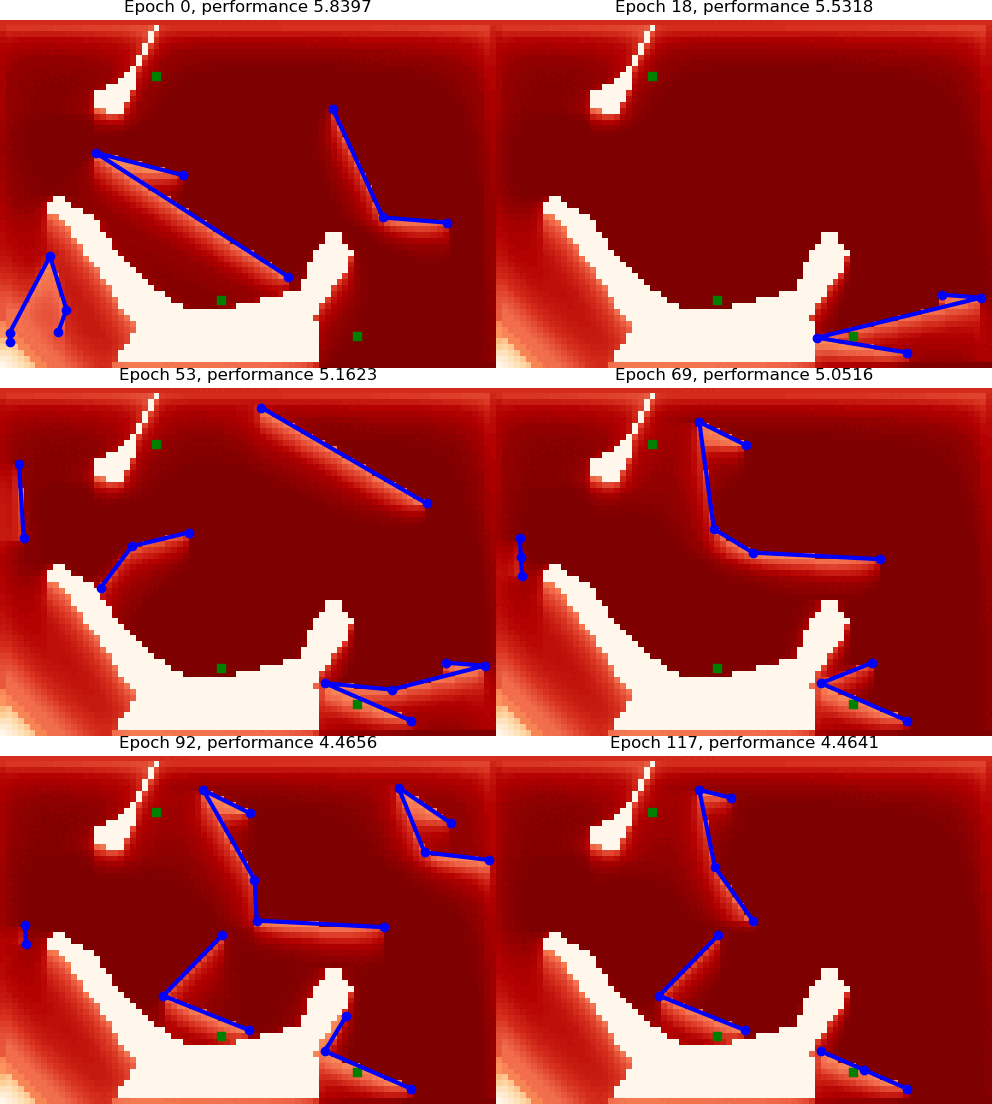
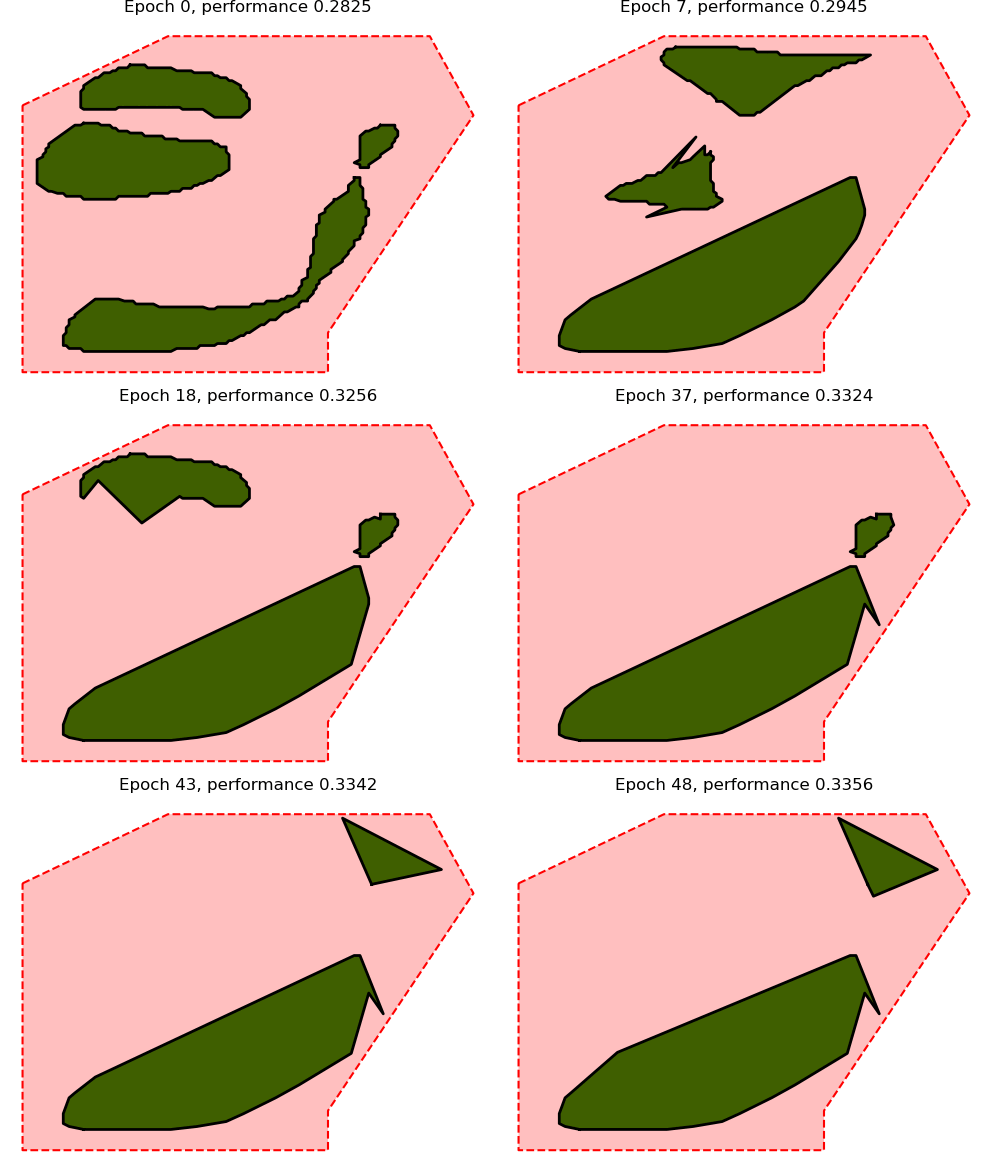
There are several examples of generative design process can be provided:
The first one is solving breakwaters task:
The second is cell trap example task:
The third is heat source example task: